
 by
by 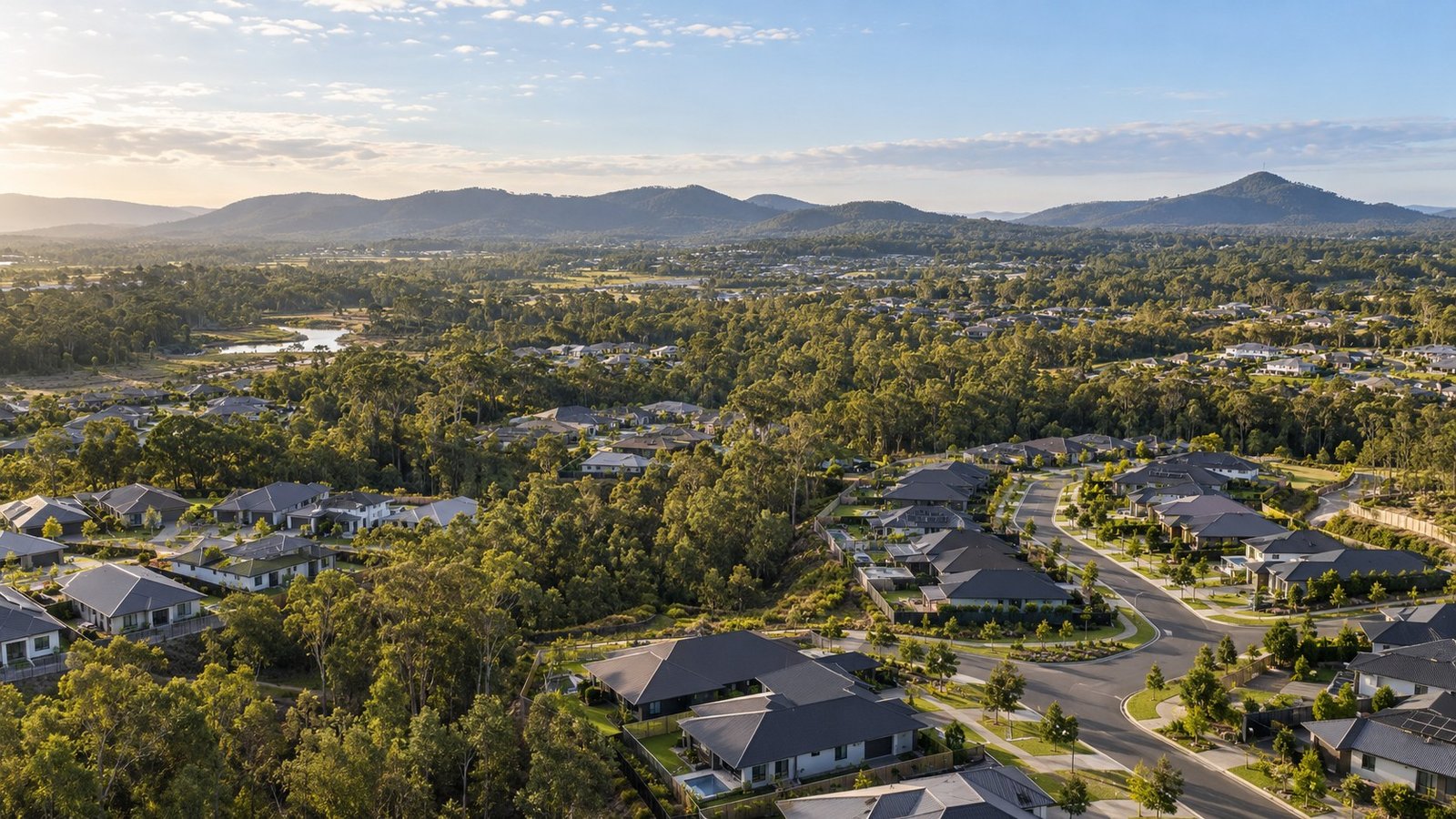
Located within the City of Logan, Flagstone sits approximately 45 kilometres south-west of the Brisbane central business district and 15 kilometres west of Jimboomba. The broader trajectory of the suburb is defined by the declaration of the Greater Flagstone Priority Development Area (PDA) on 8 October 2010. Spanning approximately 7,188 hectares, this PDA status establishes a statutory planning framework designed to facilitate rapid urban growth and structured community creation in South East Queensland.
The 2021 Demographic and Housing Baseline
To understand Flagstone’s growth context, it is essential to examine the baseline data established during the 2021 Australian Bureau of Statistics (ABS) Census. At the time of the 2021 Census, Flagstone recorded a population of 10,830 people with a median age of 29 years. This youthful age profile aligns closely with the suburb’s household composition. Family households accounted for 85.2% of all households in Flagstone, reflecting a high proportion of young families residing in the area.
Housing design across Flagstone is heavily weighted toward traditional low-density residential structures. Data from the 2021 Census shows that 98.4% of occupied private dwellings were single detached houses. From an economic standpoint, the median weekly household income was recorded at $1,885 in 2021. Note that all population, demographic, dwelling, and income statistics cited in this research are sourced directly from the 2021 ABS Census.
Master Planning and the Core Commercial Hub
Residential expansion within the suburb relies on coordinated master-planning efforts. Peet Limited serves as the primary developer driving residential master planning across the Flagstone master-planned estate project. A central component of this overall master plan is a dedicated 100-hectare City Centre. This precinct is designed to function as a commercial, retail, and civic hub for the surrounding residential development, providing designated spaces for business operations, retail services, and civic facilities.
Infrastructure and Long-Term Projections
Under the strategic planning framework of the Greater Flagstone PDA, the area is projected to accommodate approximately 120,000 residents across 50,000 dwellings at full development. It is important to clarify that this 120,000 figure represents a long-term projection rather than the current population size. The precise timeline required to achieve full development and reach this final dwelling capacity is not specified in planning documents.
Major infrastructure serving the area encompasses educational facilities, recreational parks, and planned future transport corridors for both road and rail. Strategic transport planning includes the proposed Salisbury to Beaudesert rail corridor alongside long-term road network upgrades. Specific completion dates for the rail corridor and road upgrades are not provided, and the rail corridor is not currently under construction. Instead, these transport links remain part of long-term strategic transport planning to support future growth.
Growth Context and Urban Scale
Analyzing Flagstone requires balancing its current profile as a predominantly single-detached housing community dominated by young families against its planned expansion under the Greater Flagstone PDA framework. While the 2021 Census recorded 10,830 residents, the strategic planning framework allows for significant incremental growth over time. Tracking the ongoing delivery of residential stages by Peet Limited, the progressive buildout of the 100-hectare City Centre, and the implementation of planned infrastructure will remain key markers for monitoring Flagstone’s evolution.
Join The Discussion