
 by
by 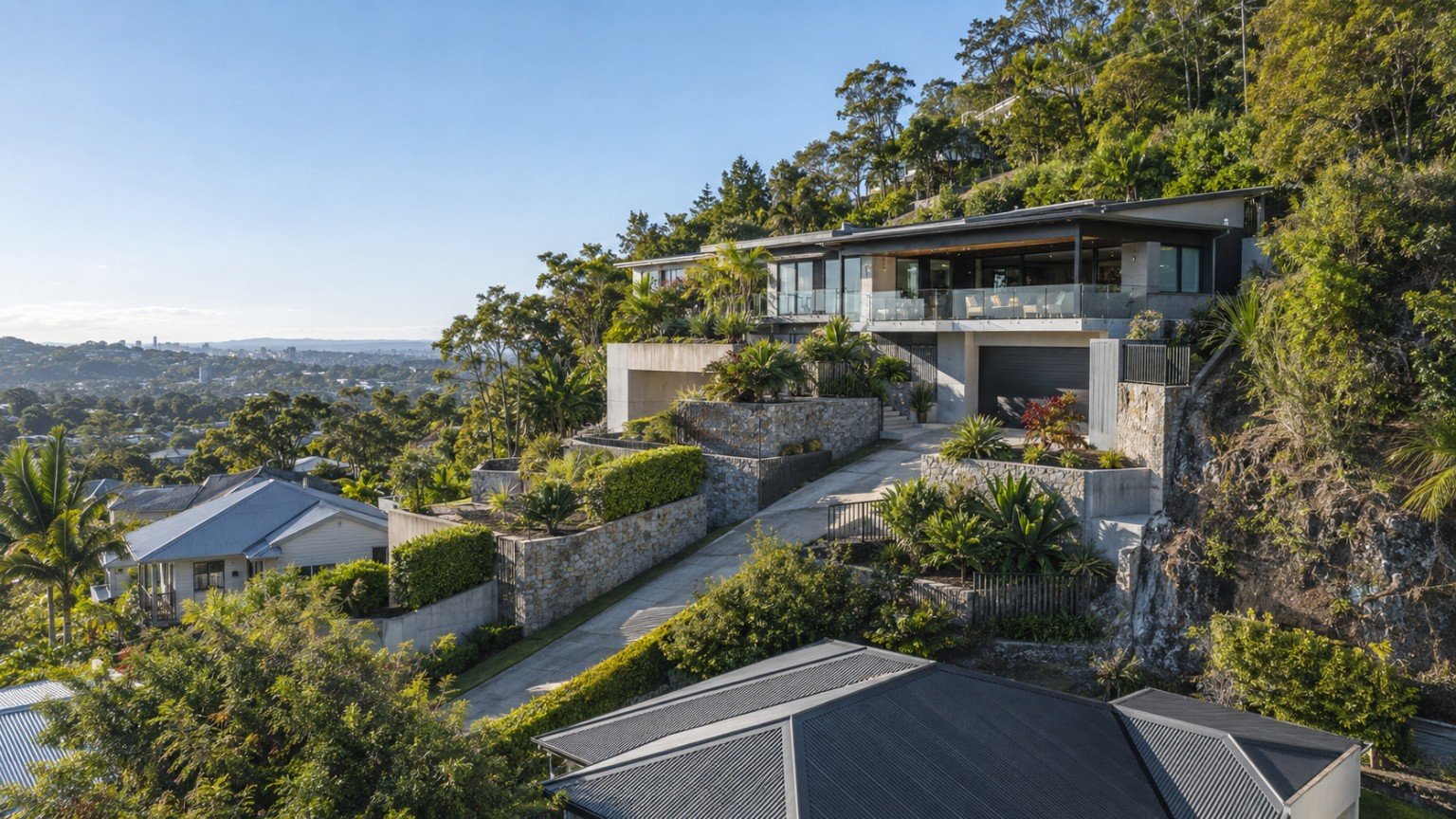
A sloping block is not automatically a problem. In Brisbane’s inner-west, the Gold Coast hinterland and the hillside estates of Ipswich and Logan, a slope is often just part of the terrain. What matters is that a sloping site changes several things about how a property is built, drained and maintained, and a buyer who treats it as one integrated research question, rather than a vague feeling about the driveway, ends up with a far clearer picture of what they are actually purchasing.
What Slope Actually Changes in a Purchase
Slope affects far more than the view. It can change excavation and retaining costs for any future work, the gradient and design of the driveway and vehicle access, whether a build uses cut-and-fill or a split-level design, where stormwater is legally allowed to discharge, the path overland flow takes across the lot in heavy rain, and even how easily construction plant and trades can access the site for future renovations. None of this makes a sloping block a poor choice. It does mean these are cost and design variables that should be understood before an offer is made, not discovered afterwards.
Retaining Walls: What to Check First
Retaining walls are usually the first thing buyers notice on a sloping property, and for good reason. In Queensland, retaining wall work above a certain height, or where extra loading (surcharge) applies nearby, is regulated building work, and a wall may also be treated as a structure under the QBCC framework. Narevella has a dedicated article covering the detail of what buyers should check on any retaining wall, so this article will not repeat it in full — read Retaining Walls: What Property Buyers in Queensland Should Check for the complete checklist.
On a sloping block specifically, ask four questions about every retaining wall you see: who owns it, whether it sits on or crosses the boundary line, whether it was ever approved, and whether any engineering certification exists for it. A wall that quietly does the job today can become an expensive unknown if it later needs replacing or repairing without documentation to work from.
Drainage and Overland Flow
A slope concentrates water. Rain that would spread evenly across a flat block instead runs downhill, which means overland flow paths matter more on a sloping site than almost anywhere else. Narevella’s dedicated drainage article explains overland flow in detail, so the short version here is the buyer action: request the council’s overland-flow or drainage mapping layer for the specific address, and ask directly where roof water and surface water are legally permitted to discharge. See Drainage, Stormwater and Overland Flow: What Queensland Property Buyers Should Check for the full framework.
Soil and Foundations
Site classification under AS 2870, the Australian Standard covering reactive soils, drives slab and footing design and cost, and reactive clay soil is common in parts of South East Queensland. This article will not state a soil classification for any suburb, because that is not something to guess at from a distance — a geotechnical or soil test is the only reliable way to know, and a site classification report is normally produced before a build contract is finalised. If you are buying with any renovation, extension or rebuild in mind, treat a soil test as a standard part of due diligence on a sloping site, not an optional extra.
Retaining Walls and the Neighbour Boundary
Where a retaining wall sits on or near a boundary, it can interact with the separate legal framework covering dividing fences between neighbouring properties in Queensland. That is a distinct topic in its own right and worth understanding if a wall doubles as, or sits close to, a fence line. Confirming exactly where the boundary runs is the first step, and Narevella’s boundaries and survey plans guide covers how to do that: Property Boundaries and Survey Plans in Queensland: What Buyers Should Know.
Landslide and Steep-Land Overlays
Several South East Queensland councils map steep-land, landslide-hazard or hillside-character constraints in their planning schemes. The instruction here is simple but important: pull the council’s planning scheme property report for the specific address, look for any slope, landslide or hillside overlay, and actually read the overlay code rather than just noting that an overlay exists. Overlay names and thresholds vary by council, so this article will not name specific overlay titles — search your own council’s planning scheme property report for the address in question. Narevella’s overlays article explains how overlays work generally: Zoning and Property Overlays in Queensland: What Buyers Should Check Before Buying.
What to Ask Your Building and Pest Inspector
On a sloping site, brief your inspector specifically on subfloor drainage and moisture, the condition of any retaining wall and how well it drains behind the wall, any evidence of ground movement or cracking, and whether any structure sits close enough to a retaining wall to fall within its zone of influence. A standard building and pest inspection should cover these points if you flag the slope in advance, and it is worth raising them again during a second inspection before you make an offer.
The Decision to Make
A sloping block is not a defect. It is a cost and design variable, and the research task is to convert the unknowns — soil, retaining walls, drainage and overlay approvals — into either a known cost you have priced in, or a clear reason to walk away. Buyers who do this work before signing tend to make calmer decisions and avoid unpleasant surprises during a build or renovation.
This article provides general research information only and is not building, engineering, planning or legal advice. Every sloping site is different, and buyers should engage a qualified geotechnical engineer, building certifier or town planner for advice specific to a property before relying on any conclusion in a purchase decision.
Useful Narevella Reading
If you are weighing up a sloping block right now, a Premium Property Review can help pull the council, overlay and title information together for the specific address you are considering.



Join The Discussion